
75% of travellers use social media as a source of inspiration when deciding their next trip (Statista). The problem is usually not a lack of interest in being there. It is two distinct things: having no social media presence, or having one but depending on you to produce every post with the few hours left in your day.
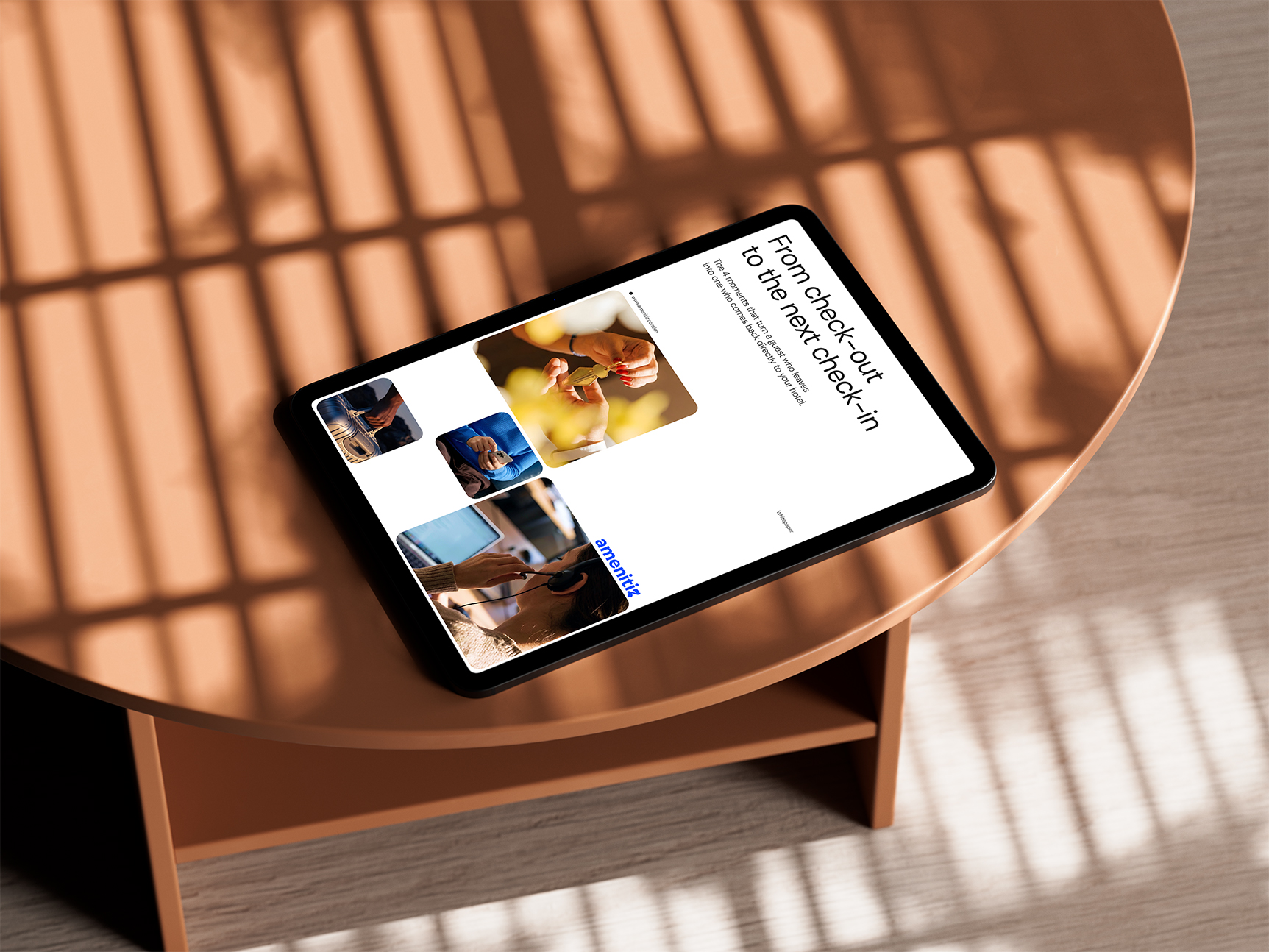
This article is a preview of what you will find in our new guide: "From check-out to the next check-in".
We will cover the following topics:
- Which social network to choose if you have little time
- What to post, so you don't have to improvise every week
- What to consider before creating content
- Whether you need to constantly invent new content
- How the Instagram algorithm works
- How often to post without burning out
Let's get into it:
1. Which Social Network Should My Hotel Use If I Have Little Time?
If you don't have social media yet, or you do but can't keep up with the pace, Instagram is the short answer. It fits better than any other with the visual and aspirational nature of travel, and it is the one that best combines discovery with real booking intent.
On accounts the size of an independent hotel (between 1,000 and 5,000 followers), a reel can reach more than 70% of the account's followers, compared to less than 20% for a photo or carousel (SocialInsider). For a hotel starting from scratch, that reach is what decides where it is worth investing time.
2. What Should My Hotel Post on Social Media?
Before thinking about how to film, there is a more important question: about what. The alternative to improvising every post is content lines, topics that repeat again and again, like the fixed segments of a news programme.
Each line should push the guest towards one of these four stages:
- Attraction: aspirational content that shows the hotel and creates desire. E.g.: the sunrise seen from the terrace.
- Connection: what makes your hotel unique. E.g.: "run by the same family since 1978".
- Trust: social proof, such as a video review.
- Urgency: tied to a specific moment. E.g.: "3 rooms left for the November long weekend".
If a post doesn't clearly fit into one of these four, it is probably redundant.
In the guide we walk you through step by step to define your own lines: what categories your specific hotel has, how to group them and how to name them.
3. What Should I Consider Before Creating Content?
Three questions, before filming anything:
- What is the goal? Which line does it belong to and which stage does it cover.
- What do I want to show? The concrete visual concept, not a generic one (not "the pool", but "breakfast by the pool at dawn").
- Why do I want to show it? What action is it looking for from the guest: that they imagine themselves there, that they trust more, that they comment.
If you can't answer all three in one sentence each, you are not yet ready to film.
4. Do You Need to Invent New Content Every Week?
No. Seeing what already works on similar accounts gives real information about which formats generate interest, rather than guessing. Search by topic ("family hotel", "boutique hotel"), look for accounts of a similar size to yours (not chains), and check the accounts Instagram suggests when you visit a similar profile.
Copying a format is not copying an account: note the angle, the duration, the type of music, and adapt it with your own content.
In our guide we explain in detail how to look for references.
5. How Does the Instagram Algorithm Work?
Instagram doesn't show the same thing to everyone and doesn't publish its exact formula, but to understand the logic, imagine that each interaction is worth different points: 1 point for a like (given in passing, without thinking), 3 points for a comment (real interest), 5 points for saving or sharing (it was useful enough to go back to).
That is why the number of likes is the least useful data point of all, both in your posts and when looking at references. And that is why it is worth closing each description with a question and a concrete action, for example "What is your favourite corner of the hotel? Tell us in the comments": it is a minimal change that turns someone who was just going to scroll past into someone who stops to write.
Beyond likes and comments, there are three metrics worth checking from time to time. You will find them in your profile, inside the Professional Dashboard, in Insights:
- Reach: how many distinct accounts saw the post, beyond your current followers.
- Saves and shares: the strongest signal that the content delivered real value, not just that it was liked in passing.
- Profile visits and clicks: measures whether the content is truly pushing towards booking.
6. How Often Should My Hotel Post?
Posting consistently generates 5 times more engagement than posting a lot sporadically. The healthy range for a small business is between 2 and 5 posts per week (Buffer).
If you have ever started posting 3 times a week and lost the rhythm after a few weeks, the problem was not the frequency. It was not having a sustainable system: without defined content lines, every post requires starting from scratch.
Final Thoughts on Social Media
A small account is not at a disadvantage compared to a chain on Instagram: the algorithm rewards consistency and well-thought-out content, not the size of the audience.
What makes the difference is not the budget, it is having a system: defined content lines, a clear criterion before filming, and consistency in posting. In the full guide we give you that system step by step, with the exercise to define your own content lines based on your specific hotel, and ready-made templates so you don't start from scratch every week.
Download the free guide "From check-out to the next check-in"